

Many product and marketing teams talk about funnels. Funnels are fine if you’re teaching Marketing 101. But when you’re building a product, a growth loop is where the magic happens.
Unlike funnels, loops are self-reinforcing systems where a user’s action triggers value, which drives more of that same action feeding your growth without burning through Ad budgets.
Why This Matters
Growth loops aren’t just for social networks. Any product can design a loop that:
Leverages what’s already working.
Turns one user’s actions into more value for others.
Scales without spending linearly on acquisition.
📺 Prefer to watch instead?
I walk through everything in detail (with real examples and a live demo of my Growth Loop GPT) in this video.
Case Study: LinkedIn’s Hidden Growth Engine
Here’s what happens when you sign up for LinkedIn:
You join and LinkedIn prompts you to connect your contacts.
If you say yes, LinkedIn suggests connections you already know.
You send invites some to existing LinkedIn users, some to new prospects.
New users join to accept your invite… and the cycle repeats.
The brilliance? LinkedIn isn’t paying to find these people—you’re doing the work for them. And you’re happy to, because you want a richer network.
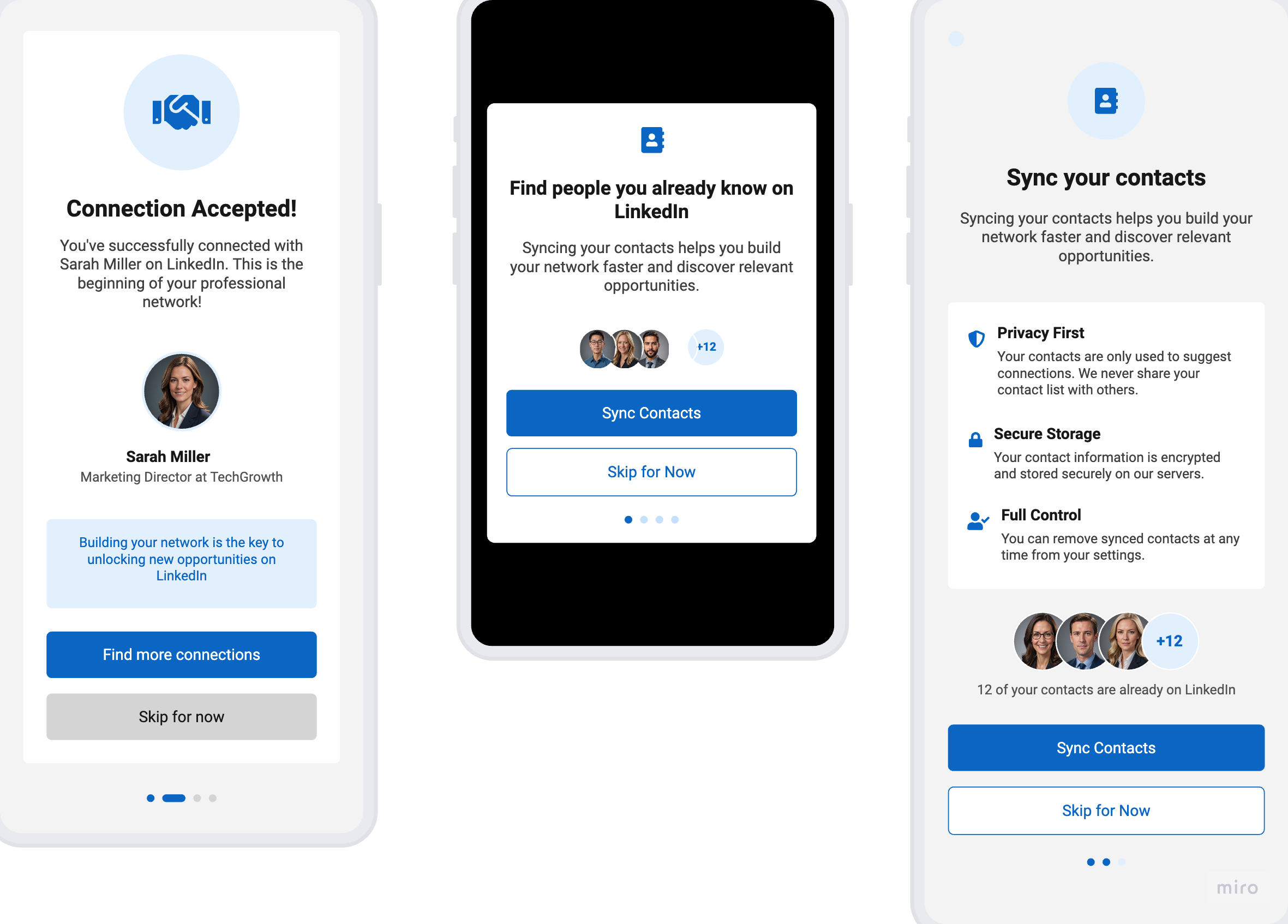
Designing a growth loop: The growth PM’s checklist
Step 1 - Assess the opportunity
Before you design anything, define what you’re trying to grow, what’s in the way, and what you already have to work with.
Example: LinkedIn’s “Sync Contacts” Loop
Goal / Growth Outcome: e.g Get new users and increase active connections.
User Hurdle: New users may not already have people to connect with
Existing Resources and the value they unlock: User’s phone contact list, LinkedIn’s recommendation engine, and invitation system.
This step ensures you’re solving for a real opportunity not just building what is possibly
Step 2 - Brainstorm features & prioritize
Once you know the opportunity, brainstorm features that could enable the loop. When you design a growth loop, think flows and steps, not just features. Instead of saying, “Let’s add invites,” you’re mapping Input → Action → Output. Where each step has a hypothesis and the riskiest step becomes your experiment focus.
To brainstorm here is the key question to ask
How might we leverage [existing resources] and the [value] it unlocks to overcome [hurdles] and achieve our [goal]?" in the action
For LinkedIn, growth loop options might include:
Loop 1 - Warm contact import
Step 1: New user imports email/phone contacts
Step 2: Matches show high-relevance connections
Step 3: User sends invites → high acceptance rate
Step 4: Larger network triggers more “People You May Know” suggestions
Step 5: User sends more invites
Why it works: Low friction, high trust, strong early acceptance feedback
Loop 2 - Mutual connections social proof
Step 1: New user connects with 3–5 initial people (workplace, school)
Step 2: Profile appears in “People You May Know” for their network
Step 3: Those mutual connections send invites back
Step 4: User sees connection notifications → sends more invites to secondary connections
Why it works: Mutual connections lower invite rejection fear and increase trust
Loop 3 - Profile completeness magnet
Step 1: User completes profile (photo, headline, experience)
Step 2: LinkedIn boosts profile in search and recommendations
Step 3: More inbound connection requests arrive
Step 4: User reciprocates by sending invites back
Why it works: High-quality profiles attract both inbound and outbound connections
Then prioritize based on what’s most likely to hit your growth outcome, in this case Loop 1 - Warm contact import
Step 3 - Identify the riskiest step / assumption
Every growth loop has assumptions. Some will break the loop instantly if they’re wrong.
Will users sync their contacts?
Do they actually want to connect with the suggested people?
Will they send invites to non-LinkedIn contacts?
For LinkedIn, the riskiest could be:
Will a new user sync their contacts right after joining?
If the answer’s no, the loop fails before it starts.
That’s the step you test first.
Step 4 - Experiment & test riskiest assumption
Design an experiment that isolates the riskiest step.
LinkedIn example:
Experiment → Prompt new users to sync contacts immediately after their first connection.
Measure → % of new users who sync + % who make connections within 7 days.
Success Criteria → Contact sync leads to a measurable uplift in connections.
If it works, you scale the loop. If not, you adjust and retest.
A Shortcut: A GPT that designs growth loops for you
Here’s where it gets fun. I’ve built a Growth Loop GPT that walks you through:
Defining your product’s growth goal.
Identifying your biggest user hurdles.
Mapping your existing resources.
Generating multiple growth loop options.
Prioritizing the loop most likely to succeed.
Outlining an experiment + metrics in under a minute.
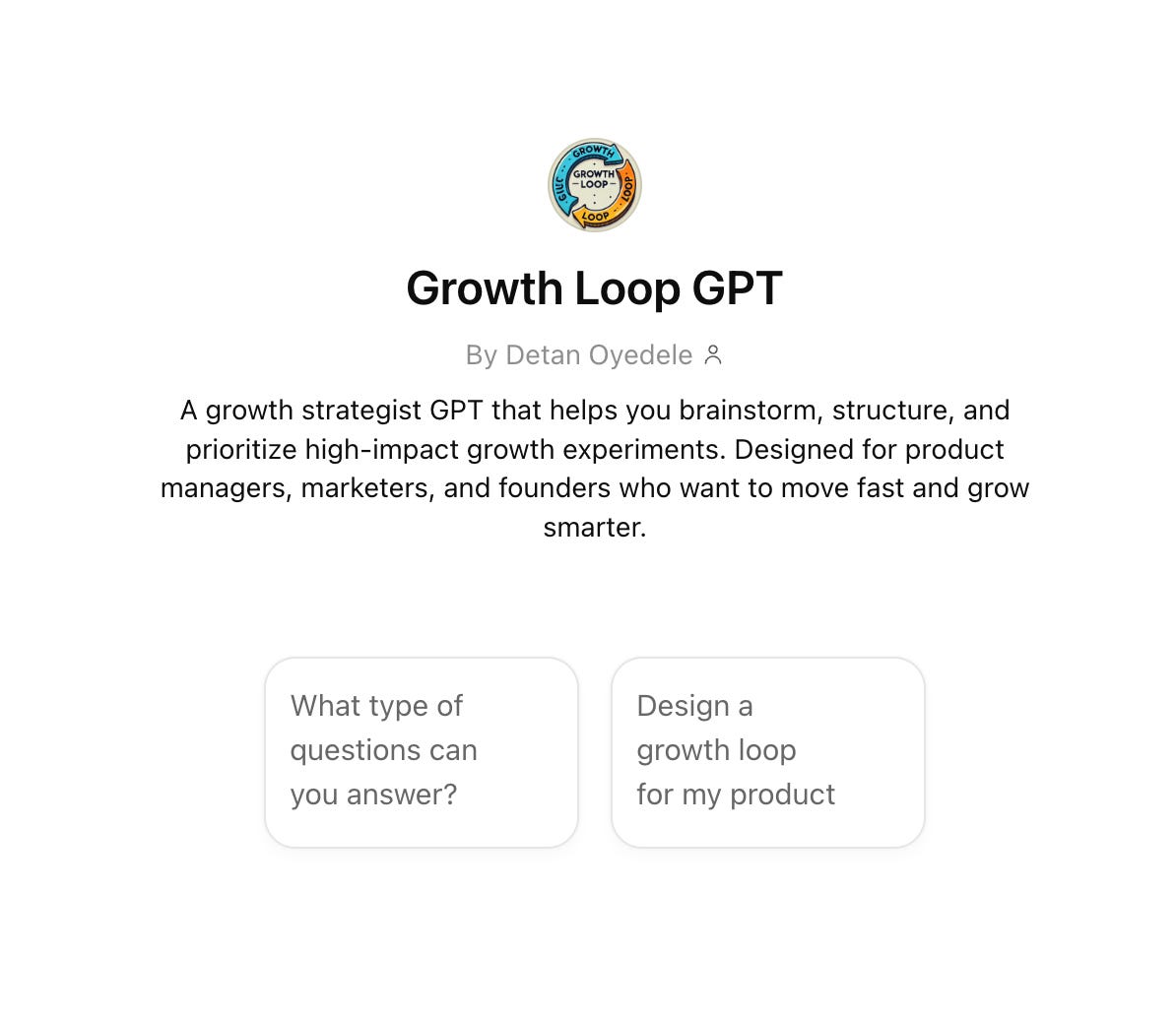
For example, I fed it:
“A productivity app for Gen Z with task tracking, calendar sync, and collaboration. Goal: improve user retention.”
It gave me three (3) growth loop options, prioritized the most promising (calendar sync → daily planning → repeat visits), and even designed the experiment:
Hypothesis: If users receive a “What’s on Today?” notification after syncing their calendar, they’ll open the app daily.
Metric: % of users returning on consecutive days.
💡 I will continue to improve the GPT, refine it and train it with more context but please give it a try and provide some feedback. Search “Growth Loop GPT” in ChatGPT, give it your product context, and let it design loops you can ship today. Then go run the experiment. Measure, iterate, scale and watch your product start compounding growth on its own.